Art History Survey 2 Late Renaissance to Post Impressionalismquizlet
Beginnings of Loftier Renaissance
The Term Renaissance
It wasn't until 1855 that a French historian named Jules Michelet commencement coined the word "Renaissance" to refer to the innovative painting, architecture, and sculpture in Italia from 1400-1530. His use of the term was informed by Renaissance historian Giorgio Vasari's mention of "rebirth" to describe the same period in his The Lives of the Well-nigh Excellent Painters, Sculptors, and Architects (also known every bit Lives of the Artists) (1568).
The term was informed past 18thursday century archaeologist and art historian Johann Joachim Winckelmann's The History of Aboriginal Fine art in Antiquity (also translated equally The History of Ancient Art) (1764) characterizing the Classical art of the Greeks as the "High Style." Winckelmann's ground-breaking book launched the study of fine art history and became foundational to European intellectual life, too as reaching a popular audition. He felt that the purpose of art was beauty, an ideal obtained by the Greeks and in Loftier Renaissance fine art, as he wrote, "the Italians solitary known how to paint and figure beauty."
By the early 1800'south the term Hochenrenaissance, German for High Renaissance, was used to refer to the menses, defined as starting time around the time of Leonardo da Vinci's The Final Supper (1490's) and ending with the Sack of Rome by the army of Emperor Charles 5 in 1527. In the last thirty years, some contemporary scholars have criticized the term as being an oversimplification.
The Transition from the Early Renaissance

High Renaissance artists were influenced past the linear perspective, shading, and naturalistic figurative handling launched past Early Renaissance artists like Masaccio and Mantegna. But they mastered those techniques in order to convey a new aesthetic ideal that primarily valued beauty. The human figure was seen every bit embodying the divine, and new techniques like oil painting were employed to convey human being movement and psychological depth in gradations of tone and color. Drawing upon the classical Greek and Roman proportional preciseness in compages and anatomical definiteness in the body, masters like Leonardo, Michelangelo, and Raphael created powerful compositions where the parts of their subjects were illustrated as harmonious and cohesive with the whole.
Leonardo da Vinci

The High Renaissance began with the works of Leonardo da Vinci every bit his paintings, The Virgin of the Rocks (1483-1485), and, nearly notably, The Concluding Supper (1490s), exemplified psychological complication, the apply of perspective for dramatic focus, symbolism, and scientifically accurate detail. However, both works were created in Milan, and it wasn't until 1500 when Leonardo moved back to Florence, the thriving middle of fine art and culture, that his piece of work impacted the city. His study for The Virgin and Child with St. Anne (c. 1499-1500) was displayed at Santissimi Annunziata church building where many artists went to study it.

Leonardo's scientific agreement and observation of natural phenomena and his sense of mathematical proportion were too profoundly influential. His seminal ink drawing Vitruvian Man (1490) showed ideal homo proportions correlating with platonic architectural proportions avant-garde past the Roman builder Vitruvius in his De architectura (30-15 BCE). The drawing is occupied by Leonardo's writing that illustrates his deep scientific inquiries into anatomy as, for instance, "the length of the outspread arms is equal to the height of a man."
Leonardo was not but a noted painter, but also a polymath who has been called the begetter of architecture, ichnology, and paleontology, among other fields. He was a noted inventor, cartographer, engineer, and his findings and observations, recorded in his notebooks, plant their way into various collections, called the Codex Arundel (1480-1518) and Codex Leicester (1510), among others. To some, these notebooks have become equally valued equally his artworks.
An Historic period of Masters and Rivalries

The High Renaissance was dominated by a few celebrated masters and the competitive rivalries that developed between them every bit they vied, not only for noble patronage, but too for supreme excellence in their fine art. In Florence, at the same time that crowds gathered to view Leonardo's cartoon for The Virgin and St. Anne (c. 1499-1500), Michelangelo had become a rising star with his creation of the Pietà (1496-1498).
Michelangelo viewed sculpture equally the pre-eminent art and, fifty-fifty in painting, sculpted the homo form. With the cosmos of the iconic statue David (1501-1504), his reputation as the sculptor whose works exemplified the High Renaissance was established. David was given a central place in the city of Florence, upholding the city-state'south spirit of defending its civil liberties.
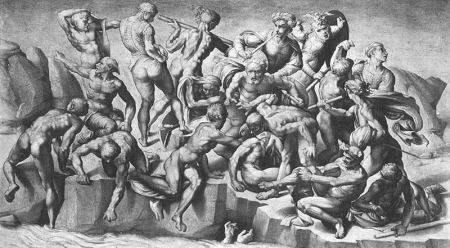
A rivalry developed betwixt Michelangelo and Leonardo, offset in 1504 with their competing frescoes commissioned for opposing walls in the Hall of 5 Hundred. Every bit art critic Jonathan Jones wrote of Michelangelo, "He was fiercely competitive and needed to outdo Leonardo. It became a contest not of skill, in which they were both beyond compare, but imagination and originality. Leonardo, the older artist, was already famous non just every bit a gifted painter merely a truly original mind... [Michelangelo] ready out his claim to a like kind of personal, unique vision." That personal vision tin be seen in the artist'due south choice of a boxing scene where nude bathers were attacked, thus allowing for a dynamic, and substantially sculptural, treatment of the male nude.
The two frescos, Leonardo's The Battle of Anghiari (1503-1506), and Michelangelo's Battle of Cascina (1504-1506), were unfortunately non completed, every bit both men were pulled toward other commissions. Still the works continued to influence other artists, notably Raphael, who would go on to copy the masterpieces in efforts to farther their own artistic practices.
Pope Julius Two
Rome became the artistic eye of the High Renaissance due to the patronage of Pope Julius 2, who reigned from 1503-1513. Julius Two was a noted art collector, owning the Laocoon (c. 42-twenty BCE) and the Apollo Belvedere (c. 120-140), along with other noted classical works, which became the foundation for the Vatican'south art museums. He was a formidable personality who made the Papacy into an economic and military force that dominated much of Italy. His goal was to make Rome the cultural centre of Europe instead of Florence. To achieve this, he ardently pursued the great artists of the day, persuading Raphael to move to Rome to pigment the frescoes of the Vatican's papal apartments. After commissioning Michelangelo to create the papal tomb. he cajoled the reluctant sculptor into painting the Sistine Chapel ceiling (1508-1512). The Pope'due south appetite to rebuild St. Peter'due south Basilica and redesign the Vatican led him to recruit Bramante, Michelangelo, and Raphael into roles as architects of his grand plans. After Julius Ii'south expiry, papal patronage of the arts continued nether Pope Leo Ten, the son of Lorenzo de' Medici, patriarch of the ruling (and art loving) family of Florence.
High Renaissance: Concepts, Styles, and Trends
Renaissance Man
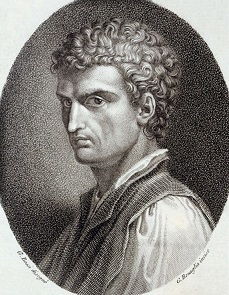
During the Early Renaissance years, the concepts of Humanism were widely promoted. Whereas the previous Gothic flow's art had emphasized the idolization of the secular and the religious, artists in 14thursday century Florence were more than concerned with human's identify in the world. High Renaissance artists evolved this research by exploring the concept of "universal man," in other words, an individual of genius, divinely inspired, who could excel in all aspects of art and science. The term "Renaissance man" is still used today to describe a well-rounded and multi-talented person who exhibits mastery in a wide array of intellectual and cultural pursuits.
This ideal, developed from Leon Battista Alberti's "A man tin can practise all things if he will," was exemplified in Leonardo da Vinci, as Vasari in his Lives of the Artists (1568) wrote, "In the normal course of events many men and women are born with remarkable talents; merely occasionally, in a way that transcends nature, a single person is marvelously endowed past Heaven with beauty, grace and talent in such abundance that he leaves other men far backside, all his actions seem inspired and indeed everything he does clearly comes from God rather than from human skill. Anybody best-selling that this was true of Leonardo da Vinci, an artist of outstanding physical dazzler, who displayed infinite grace in everything that he did and who cultivated his genius so brilliantly that all problems he studied he solved with ease."
This standard not only dominated the period but subsequent thinking on creative power, positioning the creative person equally a divinely inspired genius, rather than simply a noted craftsman.
Innovations in Painting
While Loftier Renaissance painting continued the tradition of fresco painting in connection with religious scenes, the practise of masters like Raphael, Leonardo, and Michelangelo was informed by innovations of the medium. For example, to pigment the Sistine Chapel, Michelangelo not just designed a scaffolding organization to achieve the area simply developed a new formula and awarding for fresco to counter the problem of mold, as well as a wash technique and the use of a variety of brushes, to outset apply color then, afterwards, add fine particular, shading, and line. For his Last Supper (1490s), Leonardo experimented by working on dry out fresco and used a combination of oil and tempera to achieve an oil painting outcome. Raphael, Leonardo, and Michelangelo all employed trompe l'oeil in their frescoes, a technique past which to reach the illusion of a pictorial space that integrates into its surrounding architectural environs.
At the aforementioned fourth dimension, many masterworks of the High Renaissance were, for the get-go time, being painted in oil, typically on woods panels but sometimes on canvas. Because oils provided more possibilities in subtle tonal and color gradations, the resulting works were more than life-like. As a result, a new body of compelling portraiture of ordinary people emerged. Leonardo's Mona Lisa is undoubtedly the well-nigh famous example. Other High Renaissance artists like Andrea del Sarto in his Madonna of the Harpies (1517) and Fra Bartolomeo in his Portrait of Girolamo Savonarola (c. 1497-1498) likewise created powerful works in oil.

Leonardo's do of oil painting led him to develop a new technique called Sfumato, pregnant "vanished gradually like smoke." Information technology involved using translucent glazes worked past brush to create gradual transitions between tones of light and shadow. The result was, as Leonardo wrote, "without lines or borders, in the matter of smoke," creating a vivid imitation of reality defective all prove of the artist's brushstrokes. Other High Renaissance artists like Raphael, Fra Bartolomeo, and Correggio too mastered the style, which afterward greatly influenced Renaissance painters of The Venetian School like Giorgione, and after, the Mannerist painters.
Quadratura
Quadratura was the term used for the burgeoning ceiling paintings genre of the fourth dimension, remarkable for the style they unified with the surrounding compages, and known for their employment of trompe l'oeil. These works non merely included the seamless integration between painting and location, but also oft required the creation of fictive architectural features to visually reconfigure the site. The utilize of quadratura was used oftentimes in Catholic churches to produce an monumental effect, which was in straight opposition to the movement toward Protestantism that would later get the Reformation.
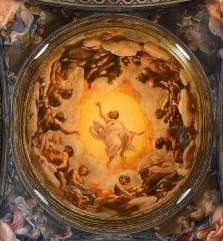
Quadratura required visual-spatial skill and a masterful employment of linear perspective that had first been pioneered by Andrea Mantegna in his Camera degli Sposi (1465-1474) ceiling in the Ducal Palace of Mantua. His work notably influenced Antonio Allegri da Correggio, known simply as Correggio, the leader of the High Renaissance in Parma.
Correggio's ceiling frescos, Vision of St. John the Evangelist on Patmos (1520-1521) and Assumption of the Virgin (1524-30), further developed the illusionary furnishings of quadratura through his use of new revolutionary techniques similar the foreshortening of bodies and objects so that they appeared authentic when seen from below. This method, besides known as prospettiva melozziana, or "Melozzo's perspective," was developed by Melozzo da Forlì, an Italian artist and architect.
Architecture

The leading architect of the High Renaissance was Donato Bramante, most noted for his emphasis on classical harmony, employment of a central programme, and rotational symmetry, as seen in his Tempietto (1502). Rotational symmetry involved the utilize of octagons, circles, or squares, and so that a edifice retained the aforementioned shape from multiple points of view. He also created the first trompe l'oeil effect for architectural purposes at the church of Santa Maria presso San Satiro in Milan. Due to the presence of a road backside the wall of the church, just three feet remained for the choir area, then the builder used linear perspective and painting to create an illusionary sense of expanded infinite.

Bramante's student Antonio da Sangallo the Younger designed the Palazzo Farnese which was chosen by Sir Barister Fletcher, "The most imposing Italian palace of the 16th century." The blueprint adhered to classical principles, had a Spartan simplicity, and used rustication, which left the building stone in its textured and unfinished land allowing for natural lines and color. The era, however, was marked past competing designs and personal rivalries. Central Farnese who became Pope Paul Iii in 1534 was dissatisfied with the cornice design of the Palazzo and held a competition for a new design, which was awarded to Michelangelo. The popular story recounts how Sangallo the Younger died of shame the following year, as Michelangelo completed the building's last touches.
Michelangelo was Bramante's chief rival, as, in afterward life, he worked as an architect. He designed the Laurentian Library in Florence and created the dome for St. Peter'due south Basilica, though the edifice as a whole reflected the work of Bramante, Raphael, and later architects like Bernini. This work, which took place between 1523-1571, was peculiarly innovative; creating a dynamic sense of movement in the staircase and wall features that was influential upon later architects.
Sculpture
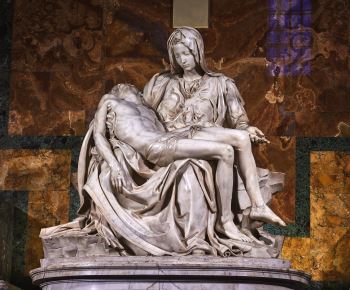
The undoubted primary of sculpture during the High Renaissance was Michelangelo whose Pietà, (1498-1499), finished when he was only twenty-four, launched his career. He chose to draw an unusually youthful Virgin Mary holding the dead Christ in her lap. Although the treatment of this scene was popular in France, information technology was entirely new to Italian fine art. The work's pyramidal composition and naturalistic figurative treatment created a powerfully classical issue. Yet, the work likewise showed innovative variations. The awe-inspiring scale of the Virgin in comparing to Christ lent a highly emotional maternal aspect to the slice and became a signature method for the artist in his work, this manipulation of high contrast. Dissimilar Early on Renaissance sculptors like Donatello who worked in bronze, Michelangelo single handedly revived the classical employ of marble, and injected elements of monumentality into all of his subsequent sculptures, both in the size of the figures, and the scale of the projects.
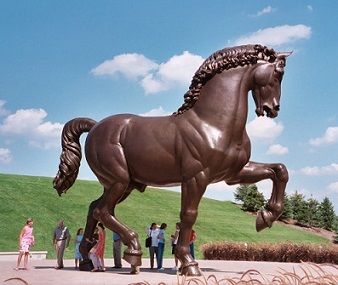
Leonardo besides explored sculpture, notably designing the world's largest statuary equestrian statue. Commissioned past the Duke of Milan in 1482 to award his father, the projection was never completed, as the artist's 24-pes alpine clay model was destroyed by the French army invasion of Milan in 1499. Several versions of the horse, based upon the creative person's drawings, have been completed in modern times.
Later Developments - After High Renaissance
The ideals and humanism that informed the High Renaissance continued to inspire the world beyond Italia, albeit with notable stylistic and artistic variation. Its influence would reach into the N European Renaissance, exemplified by Albrecht Dürer, Pieter Bruegel, and others, and the Venetian Renaissance and the Venetian Schoolhouse of Painting, led past Giorgione and Titian and the architect Palladio. Meanwhile, Correggio'southward quadratura works influenced the artists Carlo Cignani, Gaurdenzio Ferrari, Il Pordenone, and had a notable affect on Baroque and Rococo treatments of domes and ceilings.
Leonardo's expiry in 1519, followed by Raphael's decease when he was only 37 years old the following year, marked a lessened vibrancy of the Italian High Renaissance. The sack of Rome by the armies of Holy Roman Emperor Charles V in 1527 ended the era. The fell and terrifying event reduced the population of Rome from 55,000 to 10,000, and left the metropolis in a state of collapse and fiscal ruin. The ideals of the High Renaissance no longer seemed tenable to many. Michelangelo's Last Judgment (1536-41) a fresco in the Sistine Chapel expressed the darker emotional tenor of the post-obit decades. In sculpture he turned to pietas and depictions of convict slaves such as his The Atlas Slave (1530-34).
Michelangelo afterwards approaches in expression influenced the Mannerists, including Jacopo da Pontormo, Rosso Fiorentino, Giorgio Vasari, and Francesco Salviati. His figurative treatment, particularly of the male nude, influenced endless artists. Afterwards artists of the Baroque period, the Neoclassicists, and the avant-garde movements of the 20th century were too widely influenced by the works of the Renaissance. For example, Pablo Picasso drew upon Raphael in his Guernica (1937), referencing The Fire in the Borgo (1514), which depicted a woman handing her infant to those below every bit she leaned out of the called-for edifice.
The works created by the artists of the Italian High Renaissance remain the most recognizable and popular works of fine art history. The Mona Lisa, The Last Supper, The Creation of Adam, and The Sistine Madonna, accept been reproduced on countless consumer items, referenced in pop songs, TV shows, videos, and often used in advertising.
Furthermore, the ideas of the High Renaissance - the artist as genius, the foundational nature of classical art, the individual as centre of the universe, the value of science and exploration, the emphasis on Humanism - accept all deeply informed the social and cultural values of the globe ever since.
zimmermandued1938.blogspot.com
Source: https://www.theartstory.org/movement/high-renaissance/history-and-concepts/
0 Response to "Art History Survey 2 Late Renaissance to Post Impressionalismquizlet"
Postar um comentário